
Think about everything a print shop has to keep on hand - paper in half a dozen weights, toner, vinyl, laminate rolls, substrates, ink, mounting boards. All of it has to be in the right place at the right time, or jobs stall. And here's the thing: when inventory goes sideways, it rarely looks like one big disaster. It's a missed deadline here, a rush order there, a few hours a week spent by staff who are basically playing hide-and-seek with supplies instead of running the press. None of it feels huge at the moment. Add it up over a year, though, and it's a real hit to the bottom line.
The Cost of Poor Inventory Management in a Print Shop
Inventory in a print shop doesn't behave like inventory in a retail store. Every roll of vinyl or ream of stock is tied to a specific job, a specific deadline, a machine that's supposed to be running. Run out of the right paper weight halfway through a project and you're not just annoyed - you've got a stalled press, a client waiting on a delivery that's now late, and maybe a client who quietly starts shopping around for their next order.
Go the other direction and over-order, and you've tied up cash in stock that just sits there. Storage space fills up. Some materials - certain adhesives, photo papers, specialty stocks - actually expire before anyone gets around to using them. So you end up with two very different problems that somehow drain profit from the exact same source.
The Importance of Inventory Management for Print Shops
The importance of inventory management in a print business comes down to one thing: materials are typically the second-biggest expense after labor, and unlike labor, they're not predictable. Labor costs move slowly and in expected ways. Material costs swing based on waste, spoilage, miscounts, theft (yes, it happens more than owners like to admit), and forecasting that's often just a guess dressed up as a plan.
A shop that isn't tracking this closely is running production on instinct. Job costing gets fuzzy because nobody actually knows what a project costs in materials. Quotes end up based on prices that are months out of date. And usually, the damage doesn't get noticed until year-end, when someone's going through the books and wondering where all the margin went.
The Benefits of Inventory Management on Your Bottom Line
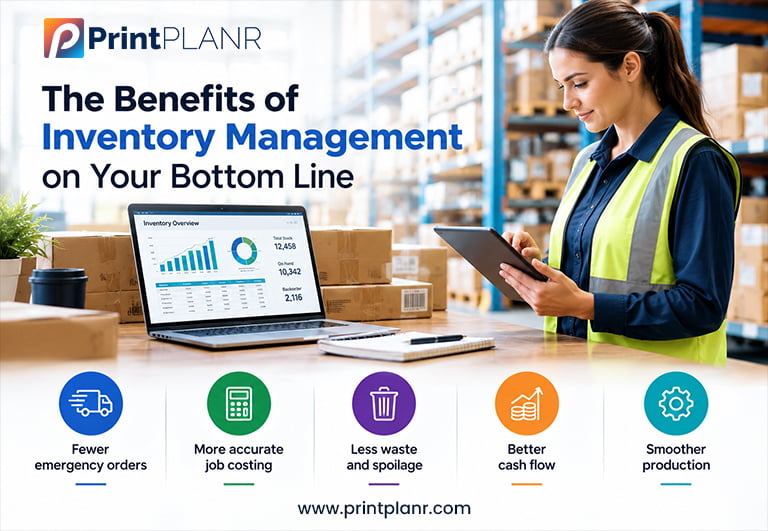
The benefits of inventory management aren't abstract. Once a shop cleans up its process, the results show up in numbers you can actually point to - not vague "efficiency gains," real line items:
-
Fewer emergency orders:
You're not paying rush-shipping premiums because something ran out at the worst possible moment.
-
More accurate job costing:
Material use gets tracked per project instead of estimated after the fact.
-
Less waste and spoilage:
Stock gets used before it expires instead of sitting forgotten on a back shelf.
-
Better cash flow:
Money isn't locked up in materials nobody's touching.
-
Smoother production:
Nobody's discovering a shortage mid-job and scrambling to fix it.
None of these are dramatic on their own - that's kind of the point. But stack them up over a few months, and a shop that trims even a small percentage off material waste and rush-order premiums can see a real jump in yearly profit, without touching a single price on the rate card.
How to Improve Inventory Management in a Print Shop
You don't need to rebuild your whole operation to fix this, honestly. The fastest path is usually just knowing what you actually have, where it is, and how fast it's moving - which comes down to a handful of habits:
-
Centralize your stock data:
instead of scattering it across spreadsheets, whiteboards, and whatever someone remembers.
-
Set reorder points:
a minimum threshold that triggers a reorder before you're scrambling, instead of waiting until a shelf looks empty.
-
Track material usage by job:
so you can actually see which projects are quietly eating your margin.
-
Run stock counts regularly:
Even quick spot checks catch problems before they turn expensive.
-
Use software built for print:
not a generic warehouse tool that has no idea what to do with a roll of vinyl measured by linear footage.
That last point is where PrintPLANR comes in, and it's worth mentioning directly since it's built for exactly this problem. PrintPLANR provides one of the best inventory management software solutions made specifically for print shops - real-time stock visibility, automated reorder alerts, and job-level material tracking, all in one system. Instead of someone trying to remember what's left in the storeroom, shops using PrintPLANR work off data that's actually current, which feeds straight into better purchasing and pricing decisions.
How to Reduce Inventory Costs Without Cutting Corners
Reducing inventory costs isn't really about ordering less - it's about ordering smarter, based on what you actually use rather than what feels safe to have on hand. A few things that help:
-
Negotiate using actual usage numbers:
not a rough guess, so you're not locked into a bulk deal you don't need.
-
Standardize materials:
where you reasonably can, so you're not managing forty SKUs when fifteen would do.
-
Watch slow-moving stock:
and adjust before it turns into dead weight.
-
Automate reordering:
so it follows real consumption patterns instead of panic-buying when someone notices the shelf's empty.
-
Check supplier reliability:
now and then - a lower price doesn't save you anything if the delivery is late every time.
Final Thoughts on Inventory Management for Print Shops
Poor inventory management almost never shows up as one big, obvious loss. It's smaller than that - a rush order this week, a roll of laminate that expired unused, a quote built on last quarter's material prices. None of it looks like much on its own. Together, it's one of the quieter ways a print shop's profitability gets chipped away.
The upside is that this is also one of the more fixable problems out there. Better visibility, smarter reordering, and the right system behind it can turn inventory from a cost you're just managing into something closer to a competitive edge. That's really the gap PrintPLANR was built to close - giving print businesses the kind of stock accuracy and control their margins actually depend on.