
The Background: A Good Print Business Constrained by Its Own Admin
This commercial print business had built a solid reputation over many years of operation. By the time they found PrintPLANR, they were not in trouble — they had a solid customer base, a capable production team, and a reputation for reliable work. The problem was more subtle than that.
A growing portion of the team's time was being consumed by operational administration that was not directly related to printing: taking orders by email, manually creating job tickets, chasing customers for files and specifications, answering "where is my order?" calls, and managing the back-and-forth that comes with a quote-first, order-second workflow.
This is an extremely common pattern in print businesses that have grown without updating their operational infrastructure. The processes that worked fine at fifty jobs a week become a genuine bottleneck at a hundred and fifty. The team ends up spending more time managing information than executing work, and sales growth is constrained because the same team that needs to take on more capacity is the one buried in admin.
The business owner recognised that the way forward was not hiring more administrative staff — it was removing the administration from the equation entirely, so the team could focus on what they were actually there to do: print.
The Challenge: What Was Actually Going Wrong
- Orders taken by email — manual data entry for every job
- Customer files arriving via email, often incomplete
- Staff spending hours each week on order administration
- Quotes created manually and sent individually to each customer
- No self-service order tracking — customers called or emailed for updates
- Disconnected systems — no single view of jobs, orders, and production
- Errors from re-keying customer specifications into job tickets
- Team capacity constrained by admin work, not by print capacity
- Customers order online — jobs created automatically in the MIS
- Artwork uploaded by customers at point of order with specifications
- Admin time reduced — team focuses on production and customer relationships
- Pricing calculated automatically based on configured product rules
- Customers track their own order status through the client portal
- Single platform for web to print, job management, and production
- Zero rekeying — all specifications captured correctly at point of order
- Sales increase as team time shifts from admin to core print work
Why They Chose PrintPLANR's Web to Print Software
The business evaluated several options before choosing PrintPLANR. The decision came down to a specific architectural difference that matters enormously in practice: PrintPLANR's web to print portal is built directly into the Print MIS, rather than being a separate eCommerce tool that requires integration with a production system.
The distinction is not subtle. With a standalone web to print platform, you solve the customer ordering experience but you still have someone on your team taking orders from the eCommerce system and entering them into your Print MIS as jobs. You have automated the customer side and left the back-office side exactly as it was.
PrintPLANR eliminates that entirely. When a customer places an order through the web to print portal, a structured job is created automatically in the MIS with all specifications, files, quantities, and pricing already captured correctly. Production stages are triggered. No one has to move information from one system to another.
The integration between web to print and Print MIS was the deciding factor. The business did not want a tool that automated customer ordering but left manual job creation intact. They needed the two sides to be the same system — which is exactly how PrintPLANR is built.
The Implementation: What the Transition Actually Looked Like
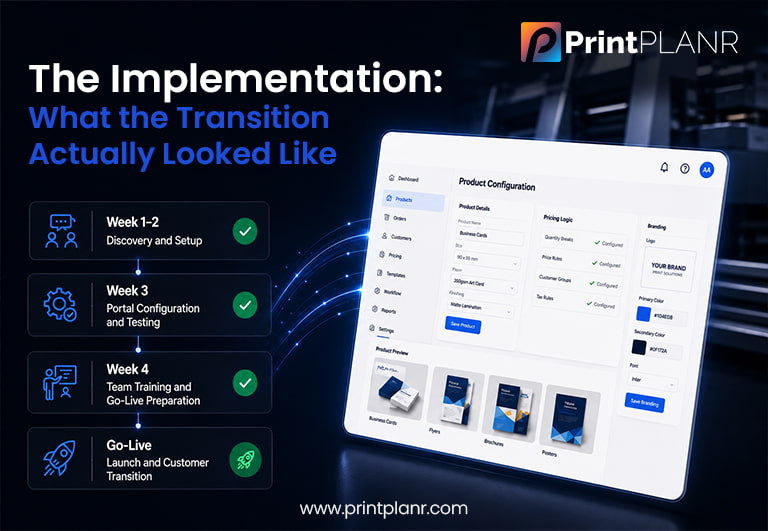
One concern many print businesses have before adopting web to print software is the complexity of the changeover. What does getting set up actually involve, and how disruptive is it to ongoing operations?
For this business, the implementation experience was summed up simply as "smooth as silk." Here is how it broke down:
What PrintPLANR Actually Replaced — Feature by Feature
The Results: What Changed After Going Live
The outcomes for this business were consistent with what PrintPLANR sees across print businesses that adopt integrated web to print software: the administrative burden reduces significantly, and the freed-up capacity converts into either higher output, more sales, or both.
What is particularly notable about this business's results is that the sales increase came not from adding headcount or changing pricing — it came from the same team being able to spend more time on the work that actually generates revenue. When the team is not buried in administrative tasks, they have capacity for more orders, better customer communication, and the kind of proactive sales activity that is impossible when everyone is treading water.
What This Means for Print Businesses in a Similar Position
This experience is not unusual. It reflects a pattern that appears consistently across print businesses that make the transition from email-based ordering to integrated web to print software: the administration that was consuming 30–50% of the team's productive time is removed from the equation, and the business grows into the capacity that was always available but tied up in overhead.
The specific mechanics vary — some businesses see the biggest gain in eliminating quote turnaround time, others in removing manual job entry, others in cutting the inbound enquiry volume from customers checking their order status. But the structural outcome is the same: the team does more printing with the same resources.
For print businesses considering the same move, this case also illustrates something important about the transition itself: it does not have to be disruptive. With a system designed for print industry operations teams rather than requiring technical expertise, and a supplier team that manages the setup process, the changeover can be managed without interrupting ongoing production. A smooth, low-disruption transition is attainable, not just aspirational.
PrintPLANR Features Used in This Case
Is Your Print Business in a Similar Position?
If your team is spending significant time on manual order entry, quote creation, and status updates, PrintPLANR's integrated web to print software and Print MIS can change that. Book a free demonstration to see exactly how it works for a business like yours.