
Why Traditional Print Management Systems Are Outdated Without AI
January 6, 2026
Can print businesses stay competitive without adopting Artificial Intelligence (AI)?
From automated job scheduling to predictive maintenance, AI in the printing industry is transforming how print service providers (PSPs) operate, optimize and deliver.
It is not just about replacing manual processes, it is about rethinking them for agility, accuracy and profitability.
According to a MarketsandMarkets report, the global artificial intelligence printing industry is expected to grow at a CAGR of 27.4% by 2030.
It is driven by increased demand for digital automation and personalized printing.
Modern printers are about thinking, learning, and adapting through print workflow automation and AI in print management tools that streamline complex operations from pre-press to post-delivery.
For the forward-looking, this evolution represents more than a trend. It is the foundation of a new, intelligent print ecosystem.
But how AI is reshaping modern print workflows and what it means for the future of print production? Let’s see
Historically, print operations were largely manual.
Each step such as job quoting, approval, scheduling and delivery required human oversight.
While this approach worked for decades, it has now become inefficient in a data-driven world that demands speed and precision.
Enter smart print workflows powered by AI. These systems do not just follow instructions, they analyze historical data, detect inefficiencies and make predictive decisions.
For example, a printing business using print workflow automation can now have its system automatically prioritize urgent jobs, allocate resources based on machine capacity and even flag potential errors before they happen.
The result? Faster turnaround times, reduced costs and happier clients.
PrintPLANR brings these innovations to life by combining automation, data analytics and AI in print management to give print businesses real-time visibility and control over every workflow stage.
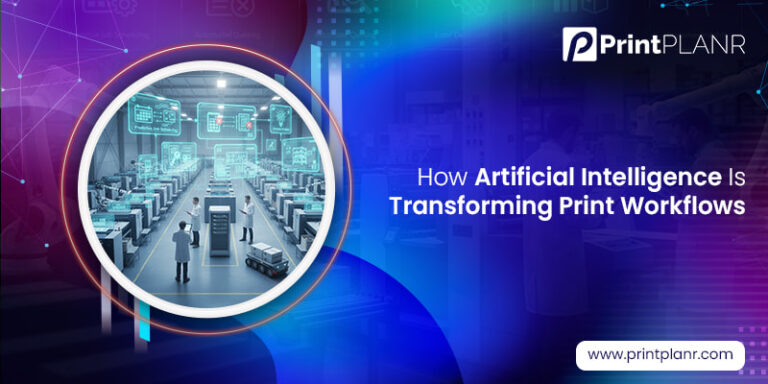
Let’s break down the key ways AI in the printing industry is transforming traditional processes into smart print workflows that deliver measurable results.
In traditional print environments, job scheduling was a manual and often error-prone task.
Operators had to estimate turnaround times and manually assign tasks.
With print operations AI, systems can automatically analyze job parameters (like size, materials and deadlines) to predict optimal scheduling.
AI ensures machines run at maximum capacity without overloading.
For instance, our print workflow automation uses AI algorithms to schedule jobs intelligently, minimizing idle machine time while ensuring delivery commitments are met.
Manual quoting often leads to inconsistencies or delays, especially when multiple pricing factors materials, ink usage, labor hours come into play.
Through AI in print management, printers can automate quotation processes. AI engines analyze previous quotes, supplier costs and production timelines to generate precise and instant estimates.
This ensures customers get accurate pricing instantly while minimizing administrative workload.
One of the biggest advantages of print production automation is real-time error detection.
AI systems use pattern recognition and image analysis to identify print anomalies before full-scale production begins.
This capability drastically reduces waste and reprints, cutting costs and ensuring consistent output quality.
Unplanned downtime is every printer’s nightmare. Traditional systems rely on scheduled maintenance, which does not account for real-time equipment wear or usage variations.
With AI in the printing industry, predictive maintenance becomes the norm. Sensors track vibration, temperature and ink flow, while AI predicts when a component might fail.
Maintenance is scheduled proactively, preventing breakdowns and extending machine lifespan.
A commercial printer using print operations AI reduced downtime after integrating predictive maintenance models into their workflow system.
Inventory management is often one of the most overlooked areas in print operations but also one of the most critical.
AI-enabled systems monitor supply levels, predict consumption trends and automate reorder requests before stock runs out.
In print workflow automation, this means your press never halts due to missing materials. AI modules help ensure that every consumable from paper to ink is available when needed, while minimizing excess stock.
AI does not just streamline operations; it enhances customer engagement. Using AI in print management, companies can analyze buying behavior, order frequency and design preferences.
This data helps personalize offers and marketing campaigns.
Imagine automatically suggesting eco-friendly materials to customers who prioritize sustainability or offering discounts to clients with recurring bulk orders.
That is how smart print workflows turn data into a competitive advantage.
Companies adopting print workflow automation are setting new standards for speed and quality.
With AI, they can deliver personalized experiences, real-time updates and predictive delivery estimates, key factors in today’s customer-driven world.
AI in the printing industry plays a crucial role in sustainability by reducing waste, optimizing ink usage and recommending energy-efficient practices.
Smarter workflows mean fewer reprints and reduced environmental impact.
As print businesses expand, managing multiple branches, clients, and workflows can be complex.
Print operations AI ensures seamless scalability, integrating easily with CRM, ERP and online ordering systems something legacy tools struggle to handle.
The future of printing is not just automated, it is intelligent. AI systems analyze vast datasets from daily print operations and turn them into actionable insights.
Managers can forecast demand, identify bottlenecks, and make informed strategic decisions.
Despite its clear advantages, some printers hesitate to adopt AI in print management due to perceived complexity or cost.
But the truth is, modern AI solutions like PrintPLANR are designed for scalability and simplicity.
Cloud-based deployment ensures minimal upfront investment, and most smart print workflows integrate seamlessly with existing systems.
Moreover, the return on investment is substantial, AI-driven printers often recover their implementation costs within the first year through reduced waste and higher efficiency.
The next wave of print operations AI will go beyond automation. We are entering an era where AI systems will self-learn from every print job, refine workflows autonomously and communicate across networks for even smarter coordination.
Upcoming innovations may include:
PrintPLANR’s continuous innovation in AI in the printing industry ensures businesses stay future-ready by combining intelligent insights with effortless automation.
The printing world is no longer about ink and paper, it is about data, intelligence, and adaptability.
Artificial intelligence printing industry advancements have transformed traditional processes into smart print workflows that are faster, leaner and more reliable.
With print workflow automation, AI in print management and print production automation, platforms like PrintPLANR empower print service providers to operate with precision, deliver on time and exceed client expectations.
In the end, the question is not if you should integrate AI into your workflows, it is how soon. Because in a world driven by intelligent automation, those who adapt first don’t just survive, they lead.
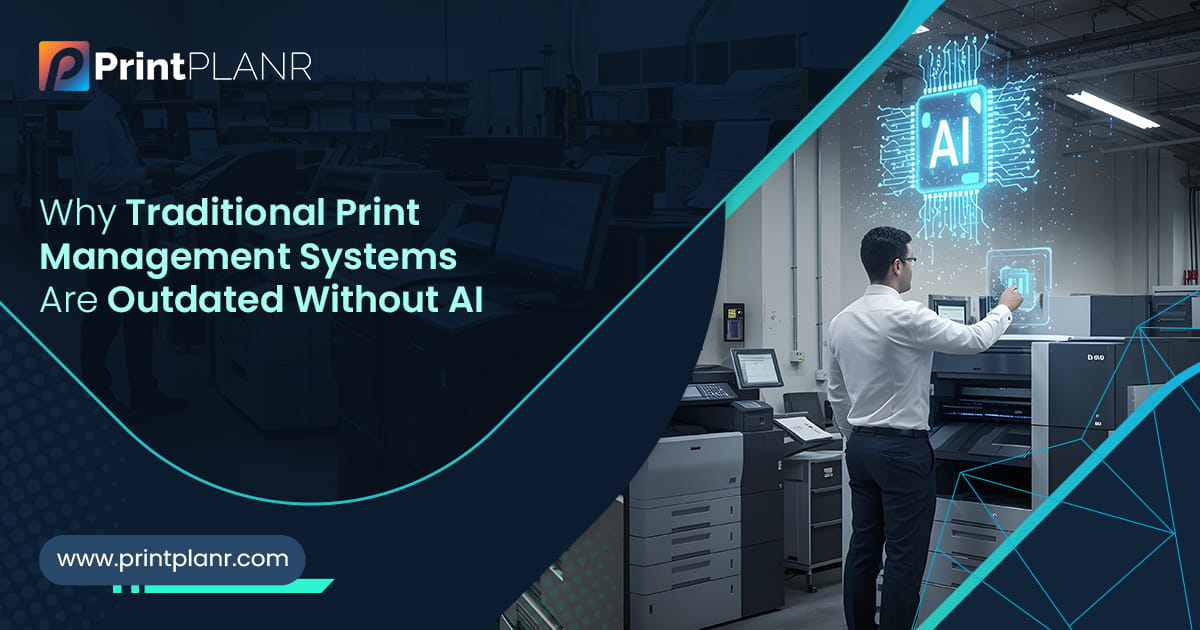
Book your free demo today and experience how our AI-powered automation platform helps print businesses enhance efficiency, accuracy, and profit margins.
See PrintPLANR in Action